October 13, 2026
Comprehending Peptide Purity Screening
By @cesarjbro531
Peptide Quality Assurance & Purity Testing Boc Sciences
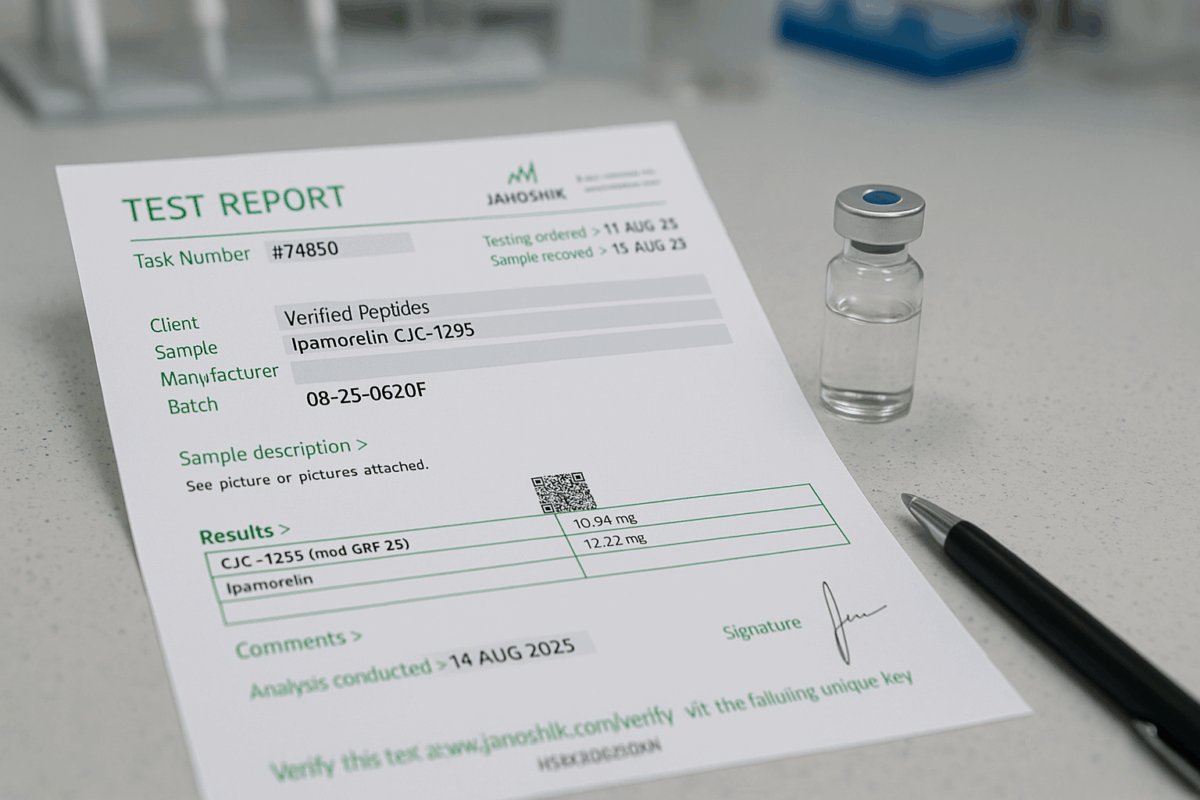
In vivo tests evaluate absorption, distribution, metabolic process, and excretion (ADME) characteristics, additionally confirming effectiveness and safety. These testing solutions not just help customers optimize items precisely during development yet also provide strong information support for governing compliance of peptide solutions. Beware of COAs that give a purity number without any sustaining chromatographic data, report pureness without defining the analytical technique, or list a molecular weight without mass spectrometry confirmation. Tandem mass spectrometry (MS/MS or MS TWO) fragments the peptide ions in the gas stage and analyses the piece masses. This is the gold standard for peptide identity-- it confirms both the composition and the sequence. For numerous peptide tasks, absolute peptide quantity matters as high as chromatographic pureness.
Residuals Testing
- Peptide pureness screening is the process of verifying that a peptide sample includes only the intended series-- and no significant impurities or by-products from synthesis.
- This front-end evaluation decreases rework and improves the chance that the very first analytical pass will certainly already be decision-useful.
- Identity screening asks whether the gauged mass or sequence-related proof matches the designated peptide.
- You can typically examine if a lab is approved by means of its web site or documentation; certification makes sure the lab's procedures and outcomes are held to international standards.
- Specially changed peptides or cyclic peptide series are difficult to verify, which affects quality control.
At Maxed Out Compounds, every product we provide includes a clear testing record and transparent documentation. Our objective is to sustain researchers with high-purity, validated compounds that fulfill the needs of modern clinical research-- absolutely nothing even more, absolutely nothing less. Independent, third-party testing plays an important duty in making sure objectivity and accuracy. By utilizing external labs for verification, vendors eliminate bias and promote scientific reliability. It's an extra step that gives researchers self-confidence that each peptide fulfills consistent, proven requirements. This grade fits most of in vitro research applications-- receptor binding assays, enzyme task researches, and cell society experiments.
The table below highlights the distinction between essential chemical and physical analysis outputs. Identification verification is reported in such a way that helps teams comprehend whether a tidy mass suit absolutely sustains the broader top quality conclusion. HPLC can reveal new pollutant tops, boosted shoulder heights, or a reduced main-peak area after storage space or handling tension.
Assistance
We support amino acid make-up evaluation and web peptide web content examination for teams that require more reputable concentration setup and set analysis. HPLC-tested means the sample was gone through high-performance liquid chromatography to divide the target peptide from impurities. The purity portion is generally determined from the main top area split by the overall integrated height location.
Begin Your Peptide Analysis Task
Not every application demands 99% purity, and filtration is a substantial component of peptide manufacturing cost. Trace quantities of solvents utilized throughout synthesis and purification-- acetonitrile, dimethylformamide (DMF), dichloromethane-- can remain in the end product. These are typically existing at really low degrees in appropriately made peptides and are controlled by ICH Q3C standards for acceptable restrictions. If the target peptide's height represent 99.1% of the overall peak location, the peptide is reported as 99.1% pure by HPLC. Lots of respectable study peptide providers make use of third-party laboratories; some conduct in-house screening with magazine of research laboratory credentials.
They are labeled "for study usage only" to make clear that they are intended for artificial insemination experiments or animal researches, not for any type of type of human usage. In fact, a laboratory offering peptide testing should deliver information meeting the rigorous logical expectations of firms like FDA and EMA [4] By using a certified third-party laboratory, peptide producers or scientists make certain an honest and skillfully documented analysis of high quality, which is precisely what inspectors try to find. In addition, ongoing independent testing sustains conformity in batch launch and quality control. Laboratory validation for peptides means using clinical tests to confirm a peptide's identity, pureness, and composition. In method, this usually involves third-party or independent screening by an outside lab to confirm that a peptide product actually has what the tag asserts [2] Irregular particle size distribution and morphology can influence bioavailability and security. BOC Sciences is geared up with tools like DLS, TEM, SEM, etc, to totally analyze nanoparticle size, distribution, and microstructure. For us, purity isn't simply a portion-- it's Synthetic Peptides a guarantee of honesty, uniformity, and respect for the scientific research being done.❧